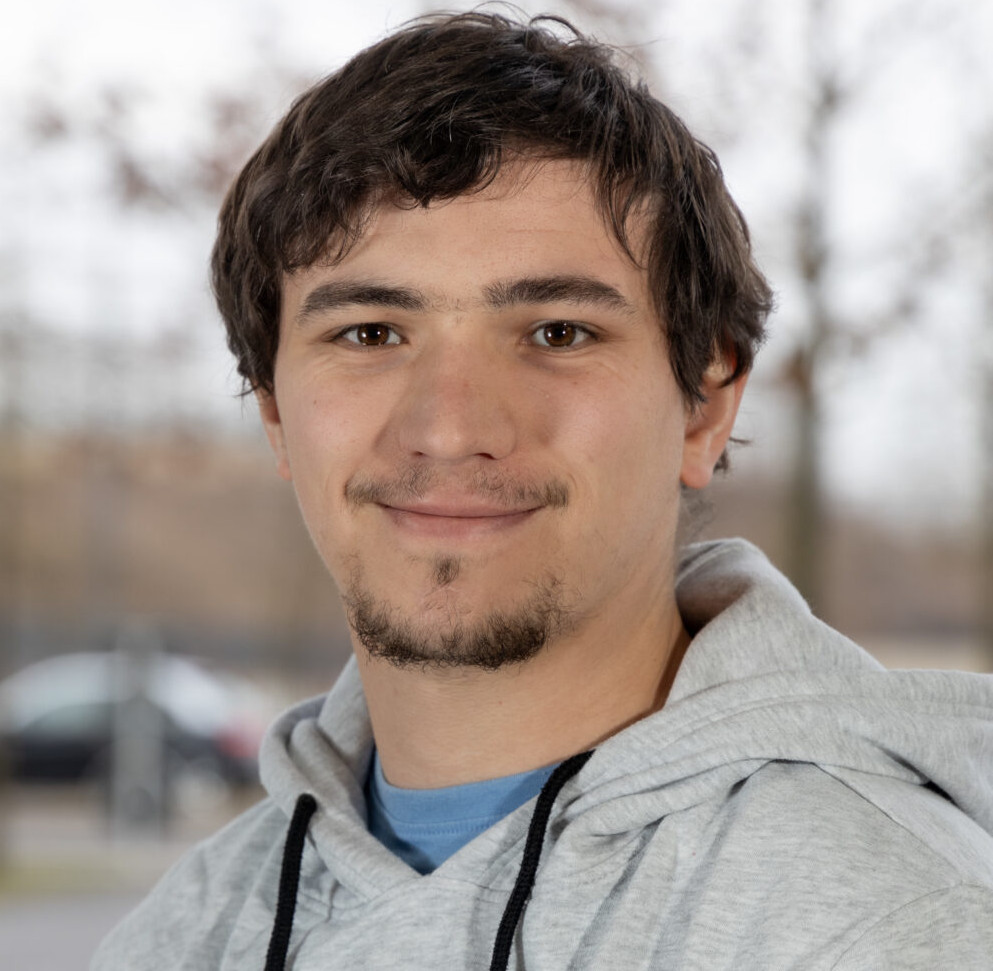
This is the website of Pierre Talbot. I'm a research scientist at the University of Luxembourg. I'm working on new theories of constraint reasoning and parallel programming. I'm also the co-director of the Master in High Performance Computing. I serve in the program committees of AAAI (since 2024) and ICTAI (since 2025).
Recruiting a postdoc in the field of neurosymbolic AI, contact me with CV if interested.
News
🎉22 September 2026: I obtained the ADR and the right to officially supervise PhD students!
15 September 2026: Welcome to Isaac Palma, starting his research on GPU-based cost network functions.
15 June 2026: Welcome to Wenbo Han and Ching-Yao Tang doing a summer internship on GPU profiling and vectorizing Turbo on CPU..
🎉12 June 2026: Manuel Combarro successfully defended his PhD on Exact Multi-objective Algorithms in Constraint Programming.
🎉29 May 2026: Yi-Nung Tsao got his paper Towards Continuous Constraint Programming for Sound Neural Network Verification accepted at LogicNN 2026 [more info].
18 May 2026: We went to the international day at the French conference JFPC 2026 and we gave two talks.
🎉1 May 2026: Manuel Combarro got his paper Combining an ϵ-Constraint Method with the Pareto Global Constraint accepted at CP 2026 [more info].
🎉28 April 2026: Tobias Fischbach successfully defended his PhD on End-to-End Quantum Circuit Optimization using ZX-Calculus.
🎉17 March 2026: Hedieh Haddad successfully defended her PhD on Hyperparameter Optimization of Constraint Programming Solvers.
15 March 2026: Welcome to Clément Poncelet, new postdoc on the project NEURESA.
🎉12 March 2026: Hakan Hasan got his first paper Towards Distributed Constraint Solving with CRDT accepted at the workshop PaPoC 2026 [more info].
1 March 2026: Welcome to Wei Huang doing his Master thesis with us on Improving the Fixpoint Engine in Turbo.
15 February 2026: Welcome to Anisa Meta doing her Master thesis with us on GPU-based Inprocessing in Turbo.
21 January 2026: An afternoon discussing about lattices, fixpoint and FPOP with Prof. Michael Adams and his students from National University of Singapore [slides].
🎉20 January 2026: Our AI-HPC BRIDGE FNR project Neuro-Symbolic Reasoning for Embedded System Architectures Design (NEURESA) with Cognifyer has been accepted.
22-25 November 2025: We had a booth at the Science Festival 2025 to explain parallel computing to kids, teens and adults. [more info]
🎉8 November 2025: Really happy my paper A GPU-based Constraint Programming Solver has been accepted to AAAI 2026 with oral presentation [more info].
3 November 2025: Welcome to Hakan Hasan who embarks with us on a PhD adventure!
11 September 2025: We organized the first parallel programming competition for MHPC students (with Paul and Wei) [more info].
2 July 2025: I presented my work on Turbo to the French conference JFPC [more info].
15 June 2025: Welcome to Wei Huang and Paul Aromolaran, students in the Master in HPC, joining the team this summer for an internship on parallel programming.
7 May 2025: During my 1-week stay at Zhejiang University (China) in the ZLAIRE laboratory, I gave a talk on abstract constraint programming on GPU [slides].
🎉2 May 2025: Our outreach activity "Supercomputer: Always Faster?" has been selected for the Science Festival 2025 in November (with Angelica Rings).
10 April 2025: I gave a talk at the IRILL (Center for Research and Innovation on Free Software) in Paris on constraint programming + GPU [slides][video (FR)].
🎉24 February 2025: Tobias Fischbach got his paper Exhaustive Search for Quantum Circuit Optimization using ZX Calculus accepted to OLA 2025 [more info].
17 February 2025: Welcome to Hakan Hasan, master student in the MHPC, who joins us for his master thesis on Multi-GPU Parallel Constraint Programming.
9 January 2025: I gave a talk at the LERIA @University of Angers on constraint programming + GPU [slides].
6-10 January 2025: I visit the University of Angers in the context of a collaboration with Éric Monfroy on the table global constraint.
28-30 November 2024: We had a booth at the Researchers' Days to explain parallel computing to kids, teens and adults :)
🎉22-30 October 2024: We were selected to participate in the Poland Open Hackathon in collaboration with mentors from Nvidia to optimize Turbo! More about our adventure and results here.
1 October 2024: Welcome to Angelica Rings, Bachelor student, who joins us to develop a video game for the Researcher's Days in the context of the project COMOC.
15 September 2024: Welcome to Francesca Guffanti, Ph.D. in mathematics, who joins us for a postdoc to strengthen the mathematical foundation of our parallel model of computation in the project COMOC.
🎉9 September 2024: Hedieh Haddad got her paper Selecting Search Strategy in Constraint Solvers using Bayesian Optimization accepted to ICTAI-24 [more info].
🎉10 July 2024: Hedieh Haddad got her paper Comparison of Hyperparameter Optimization Methods for Selecting Search Strategy of Constraint Programming Solvers accepted to PTHG-24 [more info].
🎉26 April 2024: Our proposal with Angelica Rings A Musical Game to Understand the Challenge of Collaboration in Computing for the Researchers' Days (28-30 November 2024) has been accepted.
Can abstract interpretation be the backbone theory to unify constraint reasoning approaches?
Goal I: Combine constraint solvers (by reduced products) to more efficiently solve combinatorial problems.
Goal II: Generalize reasoning procedures (e.g., propagation, multiobjective algorithms, clause learning) to monotone functions working over any abstract domains.
FNR AI-HPC BRIDGES 2026—NEURESA 2026-2029 to explore neuro-symbolic reasoning for embedded system architectures design (PI: P. Talbot, 1.135.000€).
NEURESA explores a solution to Goal I: Can LLM be useful to build constraint solvers dynamically? Project in cooperation with Cognifyer.
The lattice land project is a collection of C++ libraries implementing abstract domains such as intervals, octagons and new ones such as propagator completion.
Can lattice theory be the backbone of a safe model of parallel programming?
Goal I: Make parallel programs correct-by-construction.
Goal II: Take advantage of specialized hardware (e.g., GPUs, FPGAs, quantum architectures)
The foundation of this language is the same than for abstract constraint reasoning: lattice theory.
In short: data are lattices, programs are monotone functions and the execution is the computation of a fixpoint.
Our primary focus and application is to accelerate the algorithms developed for abstract constraint reasoning on parallel architectures.
Highlights:
Turbo is an abstract constraint solver fully executing on the GPU.
cuda-battery provides C++ data structures working on both the CPU and GPU (CUDA).
Our AAAI2022 paper describes the foundation of this parallel model of computation.
Our AAAI2026 paper describes the implementation of a GPU-based constraint solver within this model.
Paul Aromolaran, Master student, Adding Random Search in Turbo and help me to record videos on parallel computing, July-August 2025.
Collaborators and Visiting Researchers
Here the researchers with whom I have active (international) collaborations. Also the people passing by my lab :)
Francesca Guffanti
Dr. Francesca Guffanti, mathematician, postdoctoral researcher at Université Savoie Mont Blanc, France.
Previously...
A lattice-based approach for GPU programming (Postdoc 2020-2023)
I am a postdoc researcher at the University of Luxembourg in the team PCOG of the SnT laboratory.
In collaboration with Frédéric Pinel, we design a new parallel model of computation based on lattices as data structures and extensive functions as programs.
We rely on the strong theoretical fondation of lattice theory to program over massively parallel architecture, and in particular GPU.
The key insight is that a lattice structure naturally supports concurrent computations without the hassles of nondeterminism in classical system.
The primary applications will be to develop a constraint solver on GPU in this language.
This presentation gives a gentle introduction to our research.
Abstract domains for constraint programming (Postdoc 2018-2019)
I am a postdoc researcher at the University of Nantes in the team TASC of the LS2N laboratory.
The long term goal of this project is to combine concepts from the fields of constraint programming and abstract interpretation.
Constraint programming is mostly used on finite domains, although many problems are also defined on continuous domains.
Abstract interpretation provides a nice way to combine finite and continuous domains with its notion of abstract domains.
In this context, my project is to integrate integer abstract domains (such as octagons) in the constraint solver AbSolute, and to contribute to the underlying theory merging both fields.
Spacetime Programming: A Synchronous Language for Constraint Search (Ph.D. 2014-2018)
I am a Ph.D. candidate at the Institute for Research and Coordination in Acoustics/Music (IRCAM) and the Pierre et Marie Curie University (UPMC).
My thesis investigates the design of a paradigm to explore a state space with a search strategy.
This paradigm is called spacetime programming and is based on the synchronous paradigm and logic programming.
The first and major application is to enable an easy programming of search strategies in constraint solvers.
We use it to provide an interactive music composition software based on constraints.
Finally, we also explore this paradigm in the field of model checking.
My long-term research project is to unify language paradigms both on the theoretical and practical grounds.
I am sharing the code developed during this thesis through several projects available on Github, check them out!
bonsai is a language implementing the spacetime paradigm for Java.
pcp is a library for constraint solving written in the language Rust.
oak is a PEG parser investigating the notion of AST inference.